
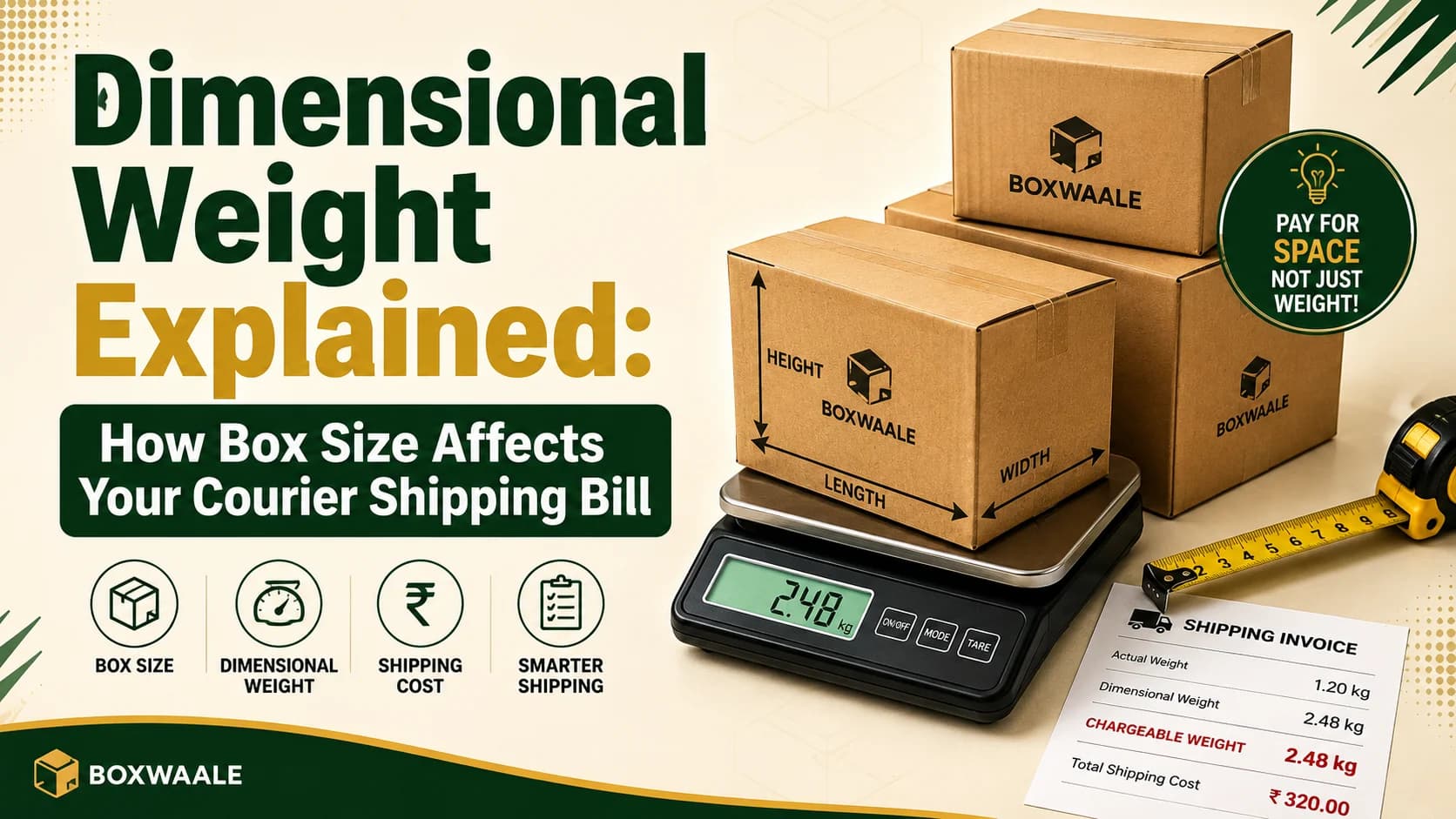
Dimensional Weight Explained: How Box Size Affects Your Courier Shipping Bill
A worked-example breakdown of how volumetric (dimensional) weight is calculated by Indian couriers, why divisors vary, and how box size — not just product weight — decides your shipping bill.
Key Takeaways
- Chargeable weight is the higher of actual weight and volumetric (dimensional) weight, not just actual weight.
- Volumetric weight (kg) = Length × Width × Height (cm) ÷ divisor; divisors commonly range from 4000-6000 depending on courier and mode.
- A loosely-packed or oversized box can cost more to ship than a snug, right-sized one — even at identical actual weight.
- Right-sizing packaging directly reduces the shipping bill, but the box must still protect the product — smaller isn't automatically better.
- Always check your specific courier's current divisor rather than assuming one universal number.
Dimensional Weight Explained: How Box Size Affects Your Courier Shipping Bill
Table of Contents
- What Is Dimensional (Volumetric) Weight and Why Couriers Charge For It
- The Formula, and a Worked Example With Real Numbers
- Why the Divisor Isn't the Same Everywhere
- How an Oversized or Loosely Packed Box Inflates Your Bill
- Right-Sizing Without Compromising Protection
- How Boxwaale Helps
- Frequently Asked Questions
If your courier bill sometimes looks higher than the shipment's actual weight would suggest, dimensional — or volumetric — weight is usually why. This article breaks down exactly how the formula works, walks through a worked example with real numbers, and explains why box size, not just product weight, quietly decides what you pay per shipment.
What Is Dimensional (Volumetric) Weight and Why Couriers Charge For It
Couriers price shipments partly by the space they occupy in a vehicle or aircraft, not only by their mass, because a large lightweight parcel takes up as much cargo space as a smaller heavy one. To account for this, every major Indian courier calculates a volumetric weight from a package's outer dimensions and bills whichever is higher: actual weight or volumetric weight. This is called the chargeable weight, and it sits on every rate card even when sellers don't notice it until an invoice comes in higher than the product's weight alone would explain.
The Formula, and a Worked Example With Real Numbers
The formula used across Indian courier rate cards is: Volumetric weight (kg) = (Length × Width × Height, all in cm) ÷ divisor.
Take a worked example. Say you're shipping a product in a box measuring 30cm × 20cm × 15cm, with an actual weight of 500g (0.5kg). The volume is 30 × 20 × 15 = 9,000 cubic cm. Using a commonly applied surface-shipping divisor of 5000, the volumetric weight works out to 9,000 ÷ 5000 = 1.8kg. Since the chargeable weight is whichever figure is higher, you're billed for 1.8kg despite the product weighing only 500g — nearly 3.6 times the actual weight, purely because of the box's outer volume. This isn't an edge case; it happens on a large share of e-commerce shipments, especially compact, light products packed in a box sized more for convenience or available stock than for the item itself.
Now compare that with a better-fit box for the same 500g product: 22cm × 15cm × 10cm. The volume works out to 22 × 15 × 10 = 3,300 cubic cm, giving a volumetric weight of 3,300 ÷ 5000 = 0.66kg. Since that's still above the 0.5kg actual weight, the chargeable weight comes to 0.66kg — still technically billed on volume rather than mass, but roughly a third of what the oversized box would have cost. The product, the courier and the divisor are identical in both examples; only the box dimensions changed, and that alone moved the bill from a 1.8kg equivalent down to a 0.66kg equivalent.
Why the Divisor Isn't the Same Everywhere
The divisor in that formula isn't universal — it varies by courier and by shipping mode. Surface or road shipments commonly use a divisor of 5000 among several major Indian couriers including BlueDart, Xpressbees and DTDC. Air cargo and international shipments often use a higher divisor, commonly around 6000, which produces a lower volumetric weight for the same box size. Some couriers, including Delhivery and Ekart, reportedly apply lower divisors — around 4000 — for certain categories, which increases volumetric weight for an identical box. Because these figures change and vary by courier, mode and even category, always confirm the current number on your specific courier's rate card rather than assuming one universal figure applies. Platforms like Shiprocket, Shipway and BigShip publish volumetric weight calculators that reflect current courier-specific divisors, and it's worth running a new SKU's packaging through one of these before finalising it.
How an Oversized or Loosely Packed Box Inflates Your Bill
Two related habits drive up volumetric weight without changing the product at all: choosing a box bigger than the product genuinely needs, and packing loosely enough that void space has to be filled with extra material. Both increase the outer dimensions that go into the volumetric formula, even though the actual product weight hasn't moved. Industry analyses of Indian e-commerce shipping note that a lightweight product shipped in a needlessly large box is often billed at two to three times its actual weight purely because of the extra volume it occupies. It's also worth noting that oversizing doesn't reliably buy better protection either — a product with too much room to move inside a box is more likely to arrive with dents or crushed corners than one that's snugly and properly cushioned, so a bigger box can mean a bigger invoice and a higher damage rate at the same time. For a systematic way to think about picking dimensions in the first place, see our guide on calculating box size for courier shipping; this article is focused specifically on how that sizing decision plays out on the invoice. Our post on why one box size doesn't fit all products and the related piece on how custom-size boxes reduce shipping cost and damage both dig further into this same mechanism.
Right-Sizing Without Compromising Protection
Right-sizing isn't the same as simply using the smallest box available — a box with too little clearance leaves no room for cushioning material, which raises damage risk for anything fragile. The practical approach is to measure the product including any manufacturer packaging, add just enough clearance for cushioning (a layer of bubble wrap or paper void-fill, not several centimetres of empty air on each side), and choose from custom or closely-stepped box sizes rather than forcing every SKU into one standard box. Sellers who standardise on just two or three box sizes across a varied catalogue often end up overpaying on volumetric weight for the smaller items in that mix, since those items are effectively subsidising the convenience of using fewer SKUs of packaging. A few habits make right-sizing manageable in practice:
- Measure the product, including any manufacturer box, before choosing packaging — rather than defaulting to whatever box is already in stock
- Add only enough clearance for cushioning material, not extra room "just in case"
- Run new SKUs through your courier's volumetric weight calculator before finalising the box size, not after the first invoice arrives
- Periodically compare volumetric weight against actual weight per SKU — a growing gap is usually the first sign that a box needs resizing
Box price is only one line item in the overall cost picture — our guide on what affects corrugated box cost in India covers the other drivers worth factoring in alongside volumetric weight.
How Boxwaale Helps
Boxwaale manufactures corrugated boxes in Delhi across both stock and custom sizes, which makes it practical to move a specific SKU out of a generic, oversized box and into a size that actually matches the product — without asking sellers to compromise on ply or protection to save on volume. If you're seeing volumetric weight consistently exceed actual weight across a product line, that's usually a sign the box size, not the courier's rate card, is the place to start looking.
Frequently Asked Questions
Related Packaging Guide
Planning a packaging order?
Turn this guidance into a box specification
Share the product dimensions, packed weight, quantity, printing requirement and delivery postcode. Boxwaale will help narrow down the appropriate size, ply and board specification before quoting.
Frequently Asked Questions
Related Products
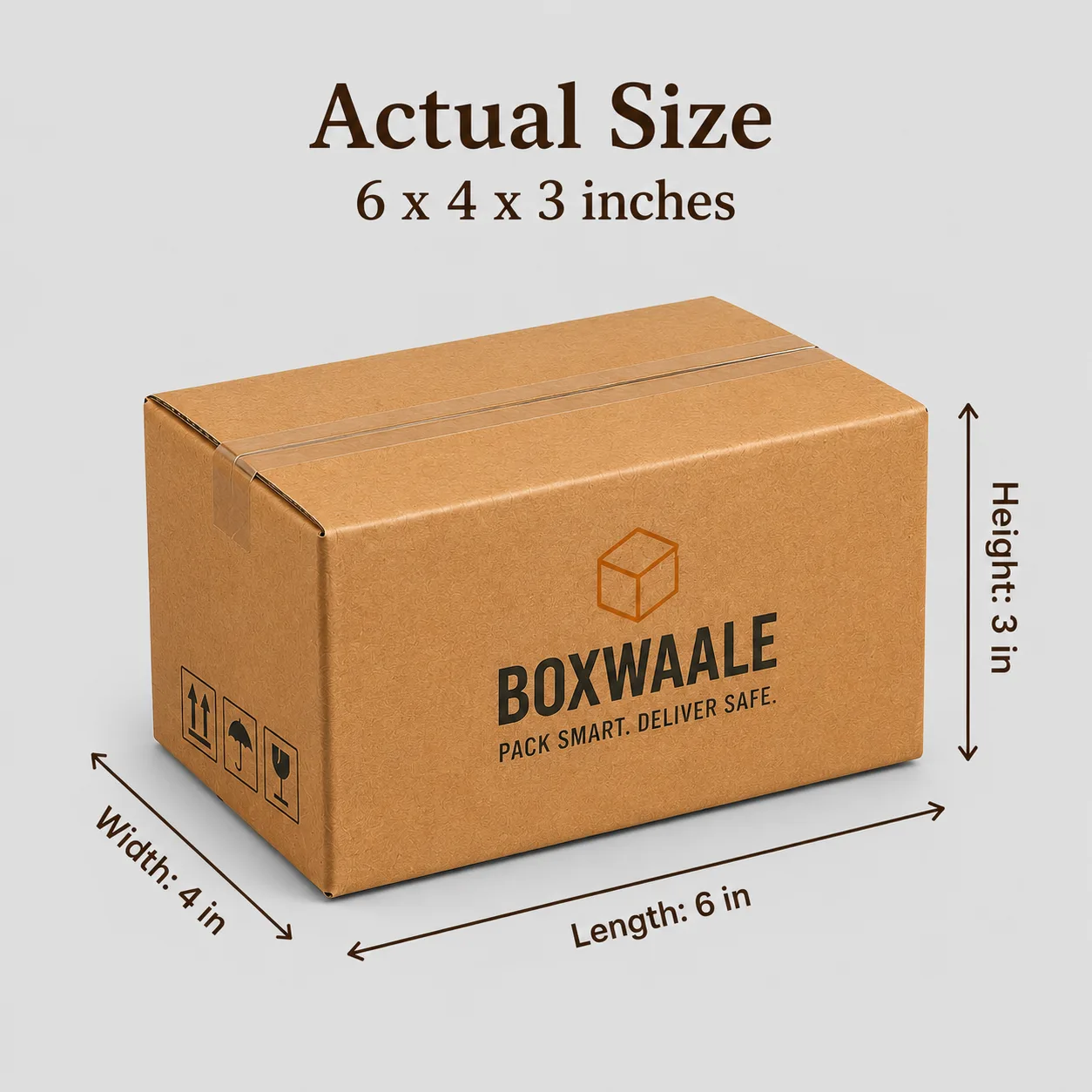
6x4x3 Inch Small Brown Corrugated Courier Box for Jewellery, Cosmetics & Accessories
Compact 6x4x3 inch brown corrugated small courier box designed for jewellery, cosmetics, mobile accessories, samples, and small product shipping.

6x4x2 Inch White Corrugated Mailer Box for E-Commerce Sellers
Premium 6x4x2 inch white corrugated mailer box designed for e-commerce sellers, D2C brands, small businesses, and courier shipping.
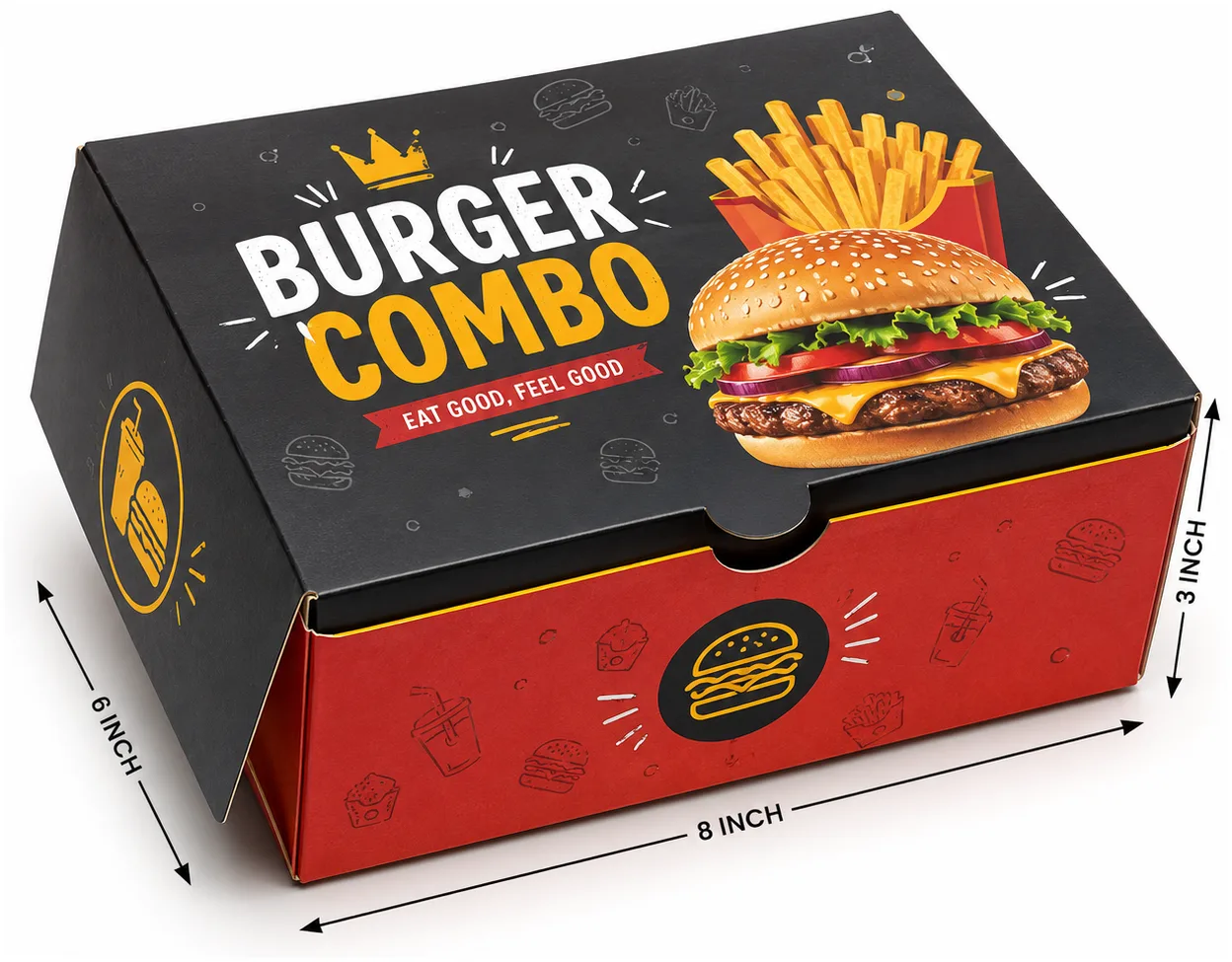
10x8x4 Inch White Courier Box for E-Commerce Sellers
Premium 10x8x4 inch white corrugated courier box designed for e-commerce sellers, retailers, warehouses, and logistics.
Related Buying Guides

How to Calculate Box Size for Courier Shipping: Length Width Height Guide
Read guide
Custom Size Packaging Boxes: Why One Box Size Does Not Fit All Products
Read guide
Packaging Box Price Guide: What Affects Corrugated Box Cost in India?
Read guide
Why Custom Size Boxes Reduce Shipping Cost and Product Damage
Read guide